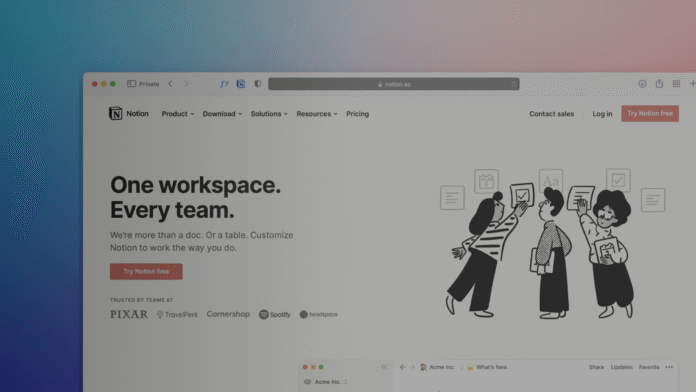
Notion’s Slack-era makeover is over — now it wants the CRM budget
The productivity darling that once sold itself as a place for notes is edging into sales software. In quick succession this spring, Notion shipped an in-app email client, survey forms that pipe answers straight into any database, and an AI template that scores leads the moment they hit the table.
COO Akshay Kothari previewed the bundle during a March livestream. “The starter CRM should live where the work happens,” he said, hinting that the company is happy to leave enterprise-grade bells and whistles to Salesforce.
What the update actually adds
- Notion Mail — An inbox that looks like any other Notion page. Messages arrive tagged to boards such as Leads or Receipts, and a /summarize command spits out bullet-point recaps.
- Forms — Google-style surveys with conditional logic and reCAPTCHA; responses drop into databases in real time.
- AI lead-scoring — A template that assigns points for email opens, form fills, and meetings booked.
The price math vs. HubSpot
| Plan | Monthly cost per user | Email automation | Lead scoring | Data limits |
|---|---|---|---|---|
| Notion Plus + AI | $18 | Manual sequences coming “soon” | Formula-based | 100 MB files (unlimited on paid) |
| HubSpot Starter | $20 (unlimited users) | 5 k emails, sequences, task queues | Built-in predictive | 1 million contacts |
For solo founders like Chicago consultant Jasmine Patel, the savings outweighed the missing features. “I’ll outgrow it if my list explodes,” she said, “but right now I’d rather keep $240 a year and skip another dashboard.”
What you still don’t get
- Native Outlook support (it’s Gmail-only for now).
- Bulk email sends beyond a few dozen a day.
- Pipeline forecasting or multi-channel attribution.
Industry analysts argue that’s fine — at least for companies with fewer than a thousand contacts. “HubSpot’s moat lives higher up-market,” says Jess Padgett, principal at SaaS consultancy Canalys. “The entry tier is vulnerable.”
The bottom line
Notion’s all-in-one pitch won’t make HubSpot obsolete, but it slices a chunk off the bottom rung of the ladder. If Mail exits beta with Outlook support and a lightweight sequencer, expect more budget-conscious founders to run their first pipeline without ever leaving the workspace they already use for everything else.
Figma Slides Is Coming for Google Workspace — and Designers Finally Have a Presentation Tool That Speaks Their Language
By [Your Name] | May 27, 2025
Key takeaways
- Figma’s slide mode leaves beta in Q3 at $3–$5 per user, depending on plan.
- Live components sync design changes to decks in real time — a first for mainstream slide software.
- Google Slides still wins on price, speaker tools, and offline editing.
Figma turns the design canvas into a boardroom deck
When CEO Dylan Field demoed Slides onstage at Config last summer, the pitch was simple: stop exporting screenshots of product comps; just present the real thing. Twelve months later, more than a million people a month open a Slides file, according to internal usage data shared with investors.
Why designers — and some marketers — are intrigued
- Live design components keep every button and mock-up in sync with the design system.
- Interactive prototypes play natively, eliminating GIF hacks.
- Real-time multiplayer mirrors Figma’s core canvas, so reviewers can comment during dry runs.
“Decks drift,” Field told the audience. “Slides kills drift.”
What Google Slides still does better
| Feature | Figma Slides | Google Slides |
|---|---|---|
| Speaker notes & presenter view | Basic | Mature (Q&A links, laser pointer) |
| Offline editing | Web-only | Yes, via Drive sync |
| Embedded charts | Design to image only | Live from Sheets |
| Price | $5 user/mo on paid workspaces | Included in Workspace |
Design-ops lead Laura Wong at fintech startup UnityFlow has already moved her product reviews into Slides but runs fundraising decks in Google. “Our CFO needs speaker notes,” she said. “Until Figma ships those, we’re straddling two tools.”
The bigger strategy: own everything from wireframe to launch
Slides isn’t Figma’s only land grab. The company also previewed Sites (a no-code website builder) and Make, an AI assistant that drafts screen flows. Analyst Molly Wood calls it “Adobe Cloud in reverse — start with UI design, then eat the rest.”